If you're building or widening a driveway on a rural road, county road, or any road without curb-and-gutter drainage, there's a good chance you'll be told you need a culvert. For many homeowners, this comes as a complete surprise mid-project. This guide explains what a driveway culvert is, when it's required, how it gets permitted, and exactly what the inspection process involves so you don't end up with a stop-work order.
What Is a Driveway Culvert?
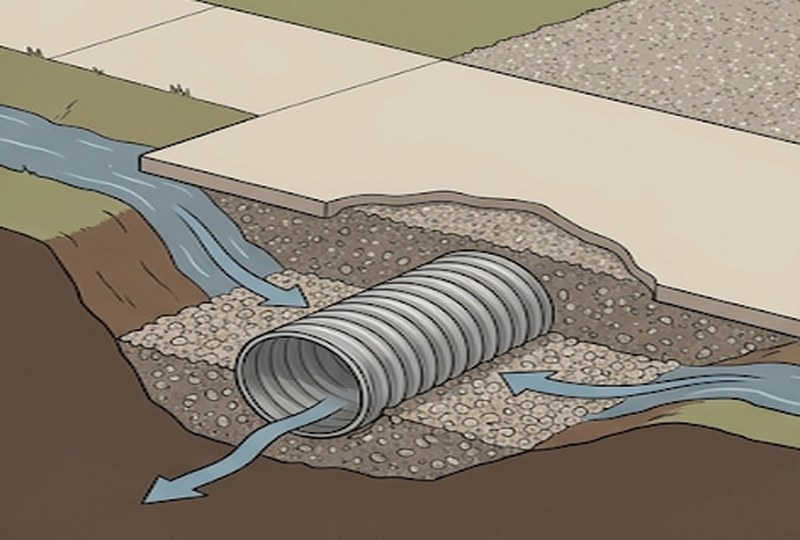
A culvert is a pipe installed horizontally under a driveway to allow water to flow through the roadside ditch without being blocked by your driveway. On roads without storm sewers and curbs, the drainage system is an open ditch running alongside the road. When you build a driveway across that ditch, you're potentially blocking stormwater flow — which can flood your neighbors, erode the roadbed, and undermine the road structure. The culvert solves this by running water under the driveway instead of blocking it.
Critical rule: On most county roads, culverts installed without a permit are subject to removal at the property owner's expense. Clinton County, Ohio, for example, explicitly states this in its access permit requirements. Don't install a culvert without getting the size and location approved first — the county may require you to dig it out and replace it with a different size.
When Is a Culvert Required?
A culvert is required when all three of these conditions exist:
- There is an open roadside ditch that carries water past your property
- Your driveway will cross over that ditch
- The road authority has jurisdiction over that ditch (county, city, or state)
If your road has curb-and-gutter drainage (the type with a raised concrete curb along the edge), culverts generally don't apply — that drainage system is enclosed. Culverts are almost exclusively a rural and semi-rural issue on roads maintained by county or township road departments.
Even on roads where culverts are common, not every property will need one. If your lot doesn't have a ditch in front of it (perhaps you're on a hill with natural drainage away from the road), the county may not require a culvert. The county engineer's pre-application site visit is the fastest way to find out.
Who Specifies the Culvert Size?
The road authority — county engineer, city engineer, or state DOT — specifies the required culvert size. You do not get to choose. This is one of the most common DIY mistakes: a homeowner installs a 12-inch culvert because it's what's at the hardware store, then fails inspection because the county required 15 or 18 inches.
Here's how specifications typically work in practice:
- Clinton County, Ohio: County engineer specifies size, length, and material. Typical residential: 15-inch diameter minimum if no existing culverts in the neighborhood; must match diameter of neighboring culverts if they exist.
- Lake County, Florida: If culvert is required, it must be the same diameter as existing culverts in the neighborhood. If none exist, minimum 15 inches diameter and 30 feet in length.
- Travis County, Texas: Minimum 18-inch corrugated metal pipe (or 15×21-inch oval pipe). Corrugated metal is the only material permitted in the Travis County right-of-way — concrete and HDPE are not accepted. Safety end treatments (concrete flared ends) are required.
- City of Pattison, Texas: Minimum 15-inch HDPE or reinforced concrete pipe. Culverts over 40 feet in length require grate inlets equally spaced. Permit fee: $250 ($150 initial review + $100 inspection).
The specifications are not negotiable. The only path to a different size is an engineering study showing that drainage calculations support a smaller pipe — and the county engineer must approve that study before you order materials.
Culvert Materials: What's Allowed
| Material | Common Name | Notes |
|---|---|---|
| Corrugated Metal Pipe (CMP) | Galvanized steel pipe | Required by many Texas counties; durable but can rust over decades |
| High-Density Polyethylene (HDPE) | ADS N-12, smooth-wall plastic | Widely accepted; lighter weight; resists corrosion |
| Reinforced Concrete Pipe (RCP) | Grey concrete sections | Very durable; heavier to handle; accepted in most jurisdictions |
| Corrugated Plastic (Standard) | Flexible black corrugated pipe | NOT accepted in many ROWs — check before purchasing |
The thin, flexible corrugated black plastic pipe sold at home improvement stores is generally not accepted for road culvert installations even though it looks similar to approved materials. Always confirm accepted materials with the permitting agency before purchasing.
Culvert Length Requirements
Culvert length is determined by the required driveway width plus additional extension on each side. Common rules:
- Culvert should extend at least 2–3 feet beyond each edge of the driveway (so a 14-foot-wide driveway needs at least an 18–20-foot culvert)
- Many counties specify a minimum regardless of driveway width — 30 feet is a common floor
- Culverts longer than 30–40 feet typically require grate inlets to prevent debris blockage
- Safety end treatments (mitered or flared ends) are required in most jurisdictions to protect vehicles that leave the road
The Inspection Process
Culvert installation is one of the few residential driveway situations where a mid-construction inspection is required — not just a final walkthrough. The critical rule:
Call for inspection BEFORE backfilling the culvert. Once the pipe is covered, the inspector cannot verify diameter, slope, end treatment, or bedding. If you backfill before calling, you may be required to excavate and expose the pipe again at your expense.
The typical inspection sequence:
Pre-installation site visit (before any digging)
County engineer visits to specify culvert size, grade, and location. Required in many counties before permit is issued.
Pipe-in-trench inspection (after pipe is set but before backfill)
Inspector verifies diameter, slope, length, end treatment, and pipe material. This is the critical inspection — do not miss it.
Final inspection (after driveway surface is complete)
Verifies apron grade, surface material, ditch restoration, and sodding of disturbed areas. Driveway slope typically may not exceed 8–14% depending on jurisdiction.
Can You Install a Culvert Yourself?
Many counties allow property owners to install their own culvert if the permit is in hand. However, most require that the installation meet the same specifications as contractor work, and some specifically require a licensed contractor for any ROW work. Check your county's requirements. If DIY is allowed, the practical constraint is equipment: a proper culvert installation requires grading the trench to slope, bedding the pipe in compacted gravel, and backfilling in lifts. Most homeowners find this exceeds DIY equipment and skill levels.
What Happens If There's Already a Culvert on Your Property
If there's an existing culvert under your driveway and you're replacing, widening, or relocating the driveway, the county will assess whether the existing culvert is adequate. If it's undersized, damaged, or doesn't meet current specifications, replacement will be required as a condition of the new permit. In some counties, any driveway permit triggers an inspection of the existing culvert — even if the culvert isn't being touched.
Culvert Permits by State
Culvert requirements are governed at the county level in most states, but some state DOTs set baseline requirements that counties must meet or exceed:
- Texas (TxDOT): Minimum 18-inch diameter CMP for state highway driveways. Safety end treatments required. For county roads, each county sets its own standard — Travis County requires CMP specifically; other counties accept HDPE.
- Florida: No statewide minimum for county roads; each county sets standards. Lake County requires matching neighborhood culvert diameter; 15-inch minimum if none exist.
- Ohio: County engineer specifies size; no statewide minimum for residential driveways. Clinton County charges no fee for culvert permits; many other counties similarly waive or reduce culvert permit fees.
- Pennsylvania: PennDOT sets standards for state road access; county and township roads have their own standards. Typically requires 15-inch minimum diameter pipe.
- California: Caltrans governs state highway connections; county roads fall under county standards which vary widely. Many California counties require engineered drainage calculations for culverts, even on residential driveways.
Measure Before the County Engineer Visits
Before your pre-application site visit, measure your ditch depth, the distance across the ditch, and your driveway width. Having these numbers ready speeds up the county engineer's visit and prevents a second trip. A 25-foot tape handles all standard residential culvert measurements.
View on Amazon →As an Amazon Associate, we earn from qualifying purchases at no extra cost to you.
Frequently Asked Questions
My ditch is very shallow — do I still need a culvert?
Possibly not. If the ditch is shallow enough that it can be graded out (sloped) to pass water under the driveway without a pipe, some counties allow a "dip-style" driveway rather than a culvert. Travis County, Texas specifically mentions this option for situations where a culvert cannot be placed at proper grade. Ask your county engineer about the dip-driveway alternative before assuming you need pipe.
Who is responsible for maintaining the culvert after installation?
You are. Once the driveway permit is closed out and the culvert is accepted, maintenance responsibility transfers to the property owner. This includes clearing debris blockages, repairing any settled sections, and replacing the pipe if it fails. Some counties will issue a citation if a blocked or failed culvert is causing road drainage problems.
Can I use the corrugated black flexible pipe from a hardware store?
Almost certainly not for a permitted ROW culvert. That material is rated for yard drainage and subsurface drain tile, not for vehicle load-bearing culvert installations under driveways. Most county ROW standards require HDPE (ADS N-12 or equivalent), corrugated metal pipe, or reinforced concrete pipe. Confirm accepted materials with your county before ordering anything.
My neighbor's culvert is a different size than what the county is requiring for mine. Why?
Culvert sizing is based on the drainage area feeding the ditch at your specific property location, not just neighborhood uniformity. A property at a low point in a watershed needs a larger culvert than one at a high point. Additionally, requirements may have changed since your neighbor's culvert was installed — older culverts are often undersized by today's standards and grandfathered in until they're replaced.
What if the county requires a culvert but my project is a driveway replacement in the same location?
If the existing driveway has a culvert, same-location replacement typically requires a culvert assessment but not automatic replacement. If the existing culvert is in good condition and meets current size standards, the county may allow you to leave it in place. If it's undersized or failing, replacement is usually required as a condition of the permit.
Related guides: New Driveway Permit · Widening a Driveway · What Is a Right-of-Way? · Texas Driveway Permits · Ohio Driveway Permits
Disclaimer: This page provides general informational guidance. Culvert specifications are set by individual county and municipal authorities and vary significantly. Always verify requirements with your local county engineer or public works department before purchasing materials or beginning work.