Texas is one of the most complex states for driveway permits because authority is highly fragmented. The same project — adding a residential driveway — can require a TxDOT permit, a county permit, or a city permit depending entirely on which road your driveway connects to. There is no state-level building permit for driveways; each jurisdiction sets its own rules. This guide explains the three-tier system and what each path looks like in practice.
Who Has Jurisdiction in Texas: The Three-Tier System
Tier 1: TxDOT (State Highway)
If your driveway connects to a state highway — any road with a US, State, FM (Farm-to-Market), or RM (Ranch-to-Market) designation — the Texas Department of Transportation (TxDOT) issues the access permit. TxDOT driveway permits are the most demanding in terms of documentation and timeline:
- You must submit a formal Access Driveway Permit application to the local TxDOT district office
- A site plan showing dimensions, grades, and drainage is typically required
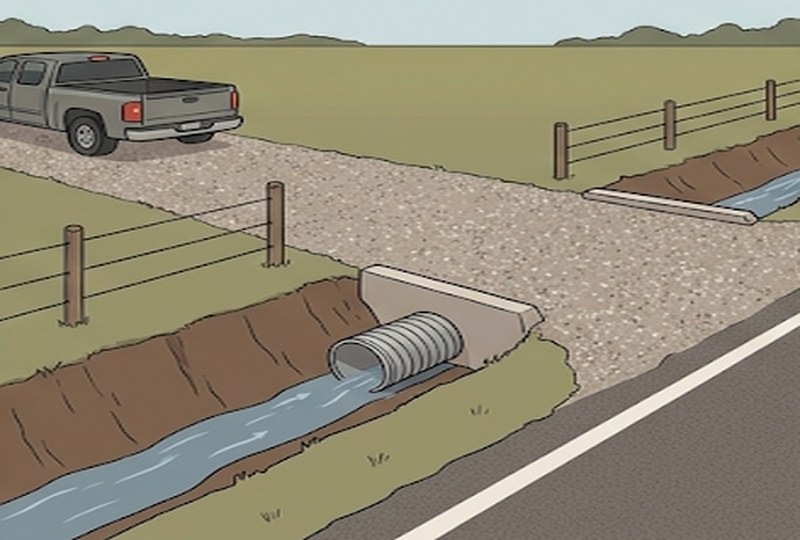
- Culvert specifications must comply with TxDOT standards: minimum 18-inch diameter corrugated metal pipe (CMP), or 15×21-inch oval pipe where round won't fit at grade
- Safety end treatments (concrete flared or mitered ends) are required on all culverts
- Sight-line distances must be documented and meet TxDOT's posted-speed-based minimums
- Review timeline: typically 4–8 weeks for residential applications
TxDOT's culvert material rule is notable: corrugated metal pipe is the only material permitted in TxDOT right-of-way for culvert installations. HDPE and concrete pipe are not accepted. This is different from many other states and catches contractors off-guard.
Tier 2: County Roads
If your driveway connects to a county-maintained road (not a state highway), the county issues the access permit. Each Texas county handles this independently. Travis County is the most documented example:
- Travis County: Minimum 18-inch CMP culvert required; driveway grade may not exceed 2% through the sidewalk zone; curb inlets require 10 feet of separation from the driveway edge. Apply through Travis County TNR (Transportation and Natural Resources).
- Harris County: County Road Department issues access permits; culvert size specified by the county engineer; concrete and HDPE pipe accepted in addition to CMP.
- Small/rural counties: Process varies widely. Some counties issue permits at the county judge's office or the road department. Fees range from free to $250. Call the county road department directly.
Tier 3: City or Municipal Streets
For driveways connecting to city-maintained streets within incorporated city limits, the city issues the permit. Every Texas city handles this differently:
- Austin: ROW permits through Austin Transportation's Right-of-Way Management Division. Online application available. Fee: varies by project scope.
- Houston: Public Works and Engineering issues ROW permits. Residential driveway apron permits typically $100–$200.
- Dallas: Department of Public Works and Transportation. Driveway permit required for any new or modified connection to a city street.
- Smaller Texas cities: City hall or city engineer — most have a one-page application and fees under $100.
City of Pattison Example: Full Fee Breakdown
As a concrete example of how Texas city culvert permits work: the City of Pattison (a small city in Waller County) charges $250 total for a driveway/culvert permit — broken down as $150 for initial review and site visit, plus $100 for the inspection. Accepted pipe materials: reinforced concrete pipe or HDPE (ADS N-12 or equivalent). Culverts over 40 feet require grate inlets. A 911 address must be obtained before the permit is issued for new construction.
Does Texas Require a Building Permit for the Driveway Itself?
The state of Texas does not require a statewide building permit for residential driveways. However, incorporated cities may require a building permit for the private-property portion of a driveway, particularly for concrete construction. In most small Texas cities and unincorporated areas, no building permit is required — only the ROW/access permit for the road connection. In major cities (Austin, Houston, Dallas), check city code: some require a minor building permit for paving above a certain square footage.
Unincorporated Areas: What Applies
In unincorporated Texas (outside city limits), there is no municipal zoning or building code — the county's access permit and any applicable county road rules are the only requirements. Most rural Texas counties require an access permit for any new driveway connection to a county road, but have no requirements for the private-property portion. If the road connecting your property is a private road rather than a public county road, no access permit may be required at all — but verify with the county engineer.
Summary Table: Texas Driveway Permit Requirements
| Road Type | Permit Authority | Culvert Material | Typical Fee | Timeline |
|---|---|---|---|---|
| State highway (US/State/FM/RM) | TxDOT district office | CMP only (18" min) | Varies; typically free–$100 for residential | 4–8 weeks |
| Travis County road | Travis County TNR | CMP only (18" min) | Varies | 1–3 weeks |
| Harris County road | Harris County Road Dept. | CMP, HDPE, or RCP | Varies | 1–2 weeks |
| City street (Austin) | Austin Transportation ROW Div. | N/A (curb & gutter) | $50–$200 | 3–7 days |
| Unincorporated (private property only) | None required | N/A | Free | N/A |
How to Find the Right Agency for Your Texas Address
- Go to the TxDOT website and search for your road. If it appears in TxDOT's road database, it's a state road — contact the TxDOT district office for your county.
- If not a state road, call your county road department (found via your county's official website) and give them your address. They will confirm if it's a county-maintained road.
- If you're within city limits, contact city hall or the city engineer's office.
- If you're in an unincorporated area on a private road, no access permit may be required — but confirm with the county.
Texas Driveway Permit FAQ
Do I need a permit to pave my driveway in unincorporated Texas?
For the private-property portion of your driveway in an unincorporated Texas area, generally no — there is no statewide building permit for residential driveways, and counties don't regulate private-property paving. However, if your driveway connects to a county road or state highway, you need an access permit for the connection point (apron), regardless of whether the private paving requires a permit.
Why does TxDOT only allow corrugated metal pipe?
TxDOT's standard specifications allow only CMP for culvert installations in state highway ROW, primarily because CMP has a long proven track record under traffic loading, is easily inspected for condition, and has standardized end-treatment options. Other materials (HDPE, concrete) may perform equally well, but TxDOT has not revised its standards to include them for residential culvert applications. County and city roads in Texas generally have more flexible material requirements.
My driveway connects to an FM road. Is that a TxDOT road?
Yes. Farm-to-Market (FM) roads are TxDOT-maintained state roads, even though they often run through rural areas. Any driveway connecting to an FM road requires a TxDOT access permit, not a county permit. Contact the TxDOT district office for the county your property is in.
How do I get a TxDOT driveway permit?
Contact the TxDOT district office serving your county — Texas has 25 districts. Submit a completed driveway permit application (available on the TxDOT website) along with a site sketch showing driveway dimensions, drainage plan, and sight-line distances. TxDOT will review and issue the permit if the application meets their access management standards. For residential applications, a licensed engineer is not always required, but complex situations (steep grades, poor sight lines, high-speed roads) may require professional help.
Related guides: Driveway Culvert Requirements · Driveway Apron Permits · Unincorporated Area Rules · Permit Checker Tool
Disclaimer: Requirements vary by county and city across Texas. This page reflects general patterns based on publicly available information. Always verify current requirements directly with TxDOT, your county road department, or your city engineer before beginning any work.